 Email Warm-up
Bulk Gmail Warm Up: App Passwords, CSV Upload, and Fleet Checks
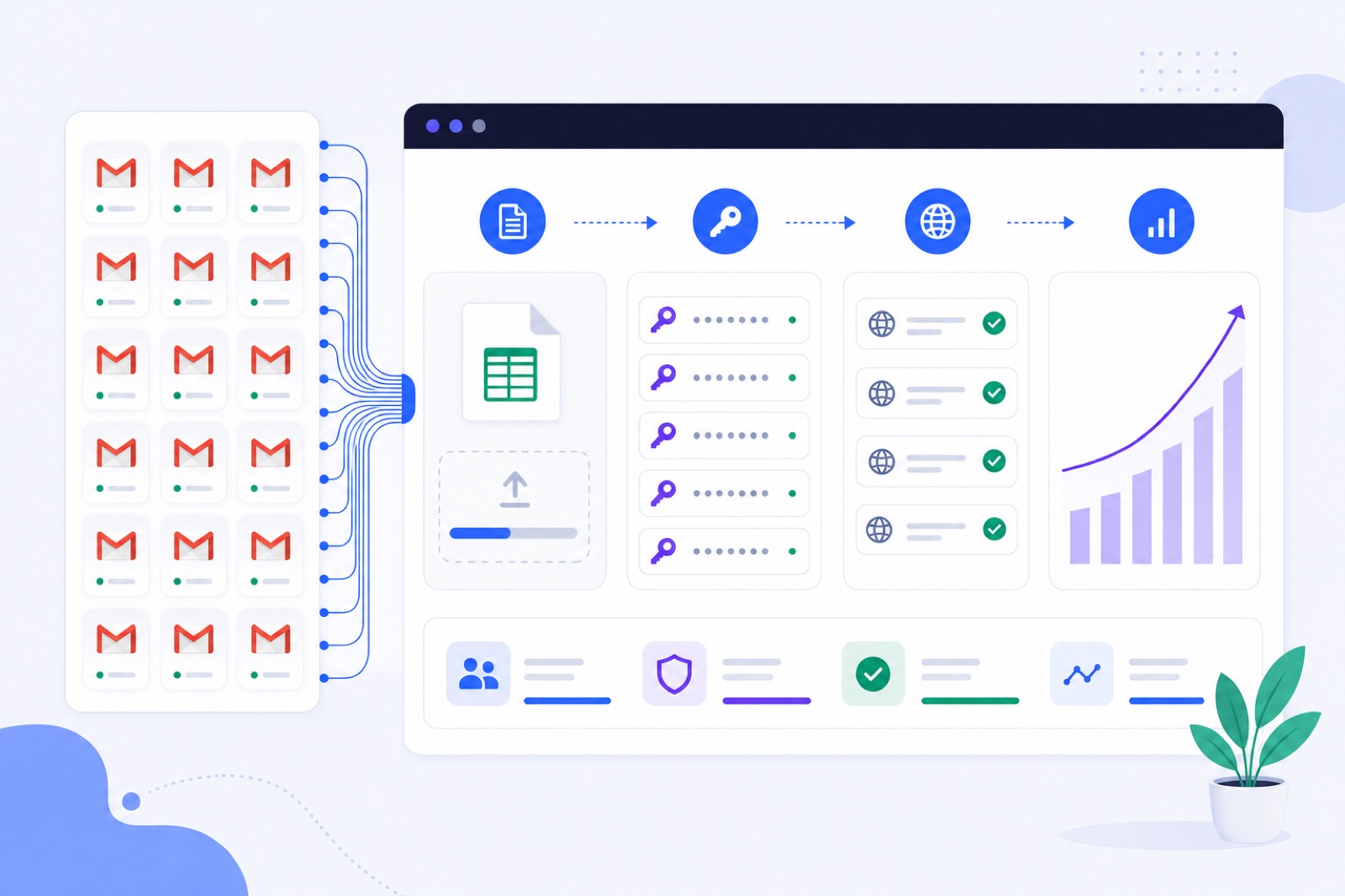
For bulk Gmail warm up, a new BobWork account costs $0 for 10 mailboxes, $120/month for 50, $180/month for 100, and $980/month for 500. If you use one-click Google sign-in, you hit Google’s unverified-app limits instead of scaling. This guide shows the app-password route, CSV upload, ramp math, pools, DNS checks and fleet health.
BobWork Email Warm-up is built for the repetitive part of this job: connecting many inboxes, ramping each mailbox, and watching spam landings per sender. If you need the single-mailbox setup first, use the Google Workspace warm-up guide. If your accounts and app passwords are ready, start with the free warm-up tool and upload the CSV.
This page is for cold email agencies, lead-gen teams and operators managing dozens or hundreds of Gmail or Google Workspace mailboxes. It is not a shortcut around reputation. You still need clean domains, sensible sending volume and mailbox-level monitoring.
What does bulk Gmail warm up cost?
BobWork gives new accounts 10 free mailboxes. Each active mailbox above 10 is paid monthly. Extras pause without billing when you pause them.
The table uses the new-account allowance. Earlier users who created accounts before 27 October 2026 keep 20 free mailboxes for as long as they use the product, so these large-fleet examples cost $20 less for them.
| Mailboxes | Free included | Paid extra | Monthly cost |
|---|---|---|---|
| 10 | 10 | 0 | $0 |
| 20 | 10 | 10 | $30 |
| 25 | 10 | 15 | $45 |
| 50 | 10 | 40 | $120 |
| 100 | 10 | 90 | $180 |
| 150 | 10 | 140 | $280 |
| 200 | 10 | 190 | $380 |
| 300 | 10 | 290 | $580 |
| 500 | 10 | 490 | $980 |
| 1,000 | 10 | 990 | $1,980 |
The default account limit is 200 mailboxes. Larger fleets, including 500 or 1,000+ mailboxes, can request a higher limit at info@bobwork.ai.
Mailboxes above the free limit need billing active before they connect. Billing is handled by Stripe, prorated, and can be cancelled any time.
If you are comparing providers for a large account base, model the full mailbox count. Per-inbox pricing compounds quickly. Use the 50+ inbox cost comparison before you commit to an agency stack.
Why use app passwords?
For Gmail and Google Workspace at scale, use IMAP with an app password. In BobWork, this is the recommended route for bulk onboarding.
One-click Google sign-in exists, but it does not scale well here. Google caps unverified apps at 100 users. BobWork has not completed the CASA audit, so Google shows an unverified-app notice and spots are limited. A Workspace admin can mark the app as trusted in the Admin console, but app passwords are still the practical bulk path.
Each mailbox needs its own app password. Do not generate one password and paste it across accounts. Google app passwords are account-specific credentials for apps that use IMAP or SMTP.
First, turn on 2-Step Verification for each mailbox in the Google Account security page. Google’s official instructions are here: Turn on 2-Step Verification.
For Workspace, the admin may need to allow 2-Step Verification for users. Do that before operators start generating app passwords.
Next, generate an app password for each mailbox. Google’s official help page is here: Sign in with app passwords. Save the generated value securely. You will paste it into the CSV as app_password. It is not the user’s normal Google password.
BobWork also needs IMAP access to receive and inspect warm-up mail. Confirm IMAP is enabled in Gmail settings or allowed by Workspace policy. Google’s IMAP reference is here: Check Gmail through other email platforms.
If an admin policy blocks IMAP, the login test will fail. Fix the policy, then re-upload the same CSV. Already-connected rows are skipped, so re-uploading is safe.
Bulk setup can trigger account checks. Work in batches, keep recovery details current, and avoid repeating failed login tests against a challenged account. If Google challenges a login, complete the check in Google first. Then retry the row in BobWork. For recovery patterns, use the Gmail unusual activity guide.
How do you upload the CSV?
BobWork supports CSV bulk upload for many mailboxes.
In the dashboard, go to:
Add mailbox → Many mailboxes: upload a CSV
Paste or upload rows with these columns:
| Column | Required for Gmail | Example | Notes |
|---|---|---|---|
email | Yes | alex@example.com | Full mailbox address |
app_password | Yes | abcd efgh ijkl mnop | Google app password, not the normal password |
name | Yes | Alex | Used for first-name greetings |
imap_host | No | blank | Gmail hosts are filled in automatically |
For Gmail, Yahoo and iCloud, BobWork fills in host settings. For other IMAP domains, add imap_host when needed.
Every row gets the same IMAP and SMTP login test as a single mailbox connection. Failed rows are listed with the reason. Already-connected rows are skipped.
That makes rework manageable. You can upload 200 rows, fix only the failures, then upload again without duplicating successful accounts.
A typical Gmail CSV looks like this:
| app_password | name | |
|---|---|---|
| alex@example.com | abcd efgh ijkl mnop | Alex |
| priya@example.com | qrst uvwx yzab cdef | Priya |
| sam@example.com | ghij klmn opqr stuv | Sam |
Keep the file private. It contains live mailbox credentials. Delete local copies after upload if your internal policy requires it.
Once connected, each mailbox ramps on its own schedule. A 500-mailbox upload is not one sender. It is 500 separate mailboxes, each starting at 3 warm-up emails per day.
BobWork Email Warm-up handles the warm-up loop after connection: sends, receives, replies, spam rescue and 7-day sender spam-rate tracking. You still decide which mailboxes stay active.
What ramp should you expect?
BobWork starts each mailbox at 3 warm-up emails per day. It adds 2 per day and caps at 30 per day by default. The cap is editable per mailbox, up to 100.
Weekends run at 30% volume. Sends are spread across 09:00–18:00 in the mailbox’s own time zone. The engine decides every 15 minutes with randomness. A pair never writes to each other twice within 3 hours.
The table below shows weekday warm-up volume. If a listed day falls on a weekend, expect about 30% of that number.
| Fleet size | Day 1 | Day 7 | Day 14 | Ramped weekday |
|---|---|---|---|---|
| 10 mailboxes | 30/day | 150/day | 290/day | 300/day |
| 50 mailboxes | 150/day | 750/day | 1,450/day | 1,500/day |
| 100 mailboxes | 300/day | 1,500/day | 2,900/day | 3,000/day |
| 200 mailboxes | 600/day | 3,000/day | 5,800/day | 6,000/day |
| 500 mailboxes | 1,500/day | 7,500/day | 14,500/day | 15,000/day |
| 1,000 mailboxes | 3,000/day | 15,000/day | 29,000/day | 30,000/day |
This is warm-up traffic, not cold outreach. Keep those plans separate.
For real outbound, keep campaigns lower: 30–50 emails per day per mailbox, with warm-up still running at 10–15 per day during campaigns. Add mailboxes instead of forcing one mailbox to carry more volume.
For smaller batches, use the email warm-up schedule guide. For new domains, plan 2–3 weeks before meaningful outbound volume. Existing domains often need at least 7 days.
Which pool mode fits your fleet?
BobWork uses a shared warm-up network by default. Every active mailbox on the service exchanges warm-up emails with other active mailboxes across accounts. One mailbox is enough to start.
For bulk Gmail fleets, choose the shared network or a private pool before you scale.
| Pool mode | How it works | Minimum mailboxes | Best fit |
|---|---|---|---|
| Shared network | Your mailboxes warm with other active mailboxes across accounts | 1 | Small batches, first tests, mixed providers |
| Private pool | Only your own account’s mailboxes warm each other | 2 | Agencies, 50+ mailboxes, internal-only warm-up |
To switch, open:
Mailbox pool → Pool mode → Private pool
Private pool means nobody outside your account receives your warm-up addresses. It also means your own fleet must provide enough variety.
For 50+ mailboxes, private pool is usually cleaner. You control the addresses, the domains and the exposure. BobWork recommends private pool for big fleets once you have enough mailboxes.
The engine still adds variety inside the pool. Peers on a different domain or provider are picked twice as often. If all 100 mailboxes sit on one domain, you lose that benefit.
Warm-up content is generated by the engine. Users do not write the messages. The emails are short plain-text office notes with no links and no images. About 40% of received warm-up mail gets a reply, and threads end after 3 messages.
For a deeper trade-off, read private pools versus public networks.
How should DNS be checked?
Bulk Gmail warm-up can mean two setups.
You may be using consumer Gmail addresses. Those accounts use Google’s domain, so you do not control SPF, DKIM or DMARC for gmail.com.
Or you may be using Google Workspace mailboxes on your own domains. That is the usual setup for cold email teams because you control the domain and DNS.
For big Workspace fleets, spread mailboxes across several domains. A typical operating range is 2–5 mailboxes per domain. Do not put 100 outbound mailboxes on one fresh domain and expect warm-up to hide the pattern.
Every sending domain needs authentication checks:
| Record | What to check | Why it matters |
|---|---|---|
| SPF | Your domain authorises the sending service | Receiving servers can verify the sender path |
| DKIM | Google signs mail with a valid selector | Receiving servers can verify message integrity |
| DMARC | Policy exists and aligns with SPF or DKIM | Providers can evaluate domain alignment |
BobWork checks SPF, DKIM and DMARC daily via DNS and shows results per domain. For Google-hosted domains, the DKIM selector commonly found is google.
Use Google’s official sender guidance for current requirements: Email sender guidelines. Google’s published complaint guidance is strict: keep spam complaints under 0.1%, and never at or above 0.3%.
For Workspace DKIM setup, use Google’s official page: Set up DKIM for Google Workspace.
DNS passing does not guarantee inbox placement. It removes obvious authentication failures. Warm-up then gives you mailbox-level behaviour signals before campaigns begin. For the full authentication walkthrough, use the SPF, DKIM and DMARC guide.
How do you read fleet health?
A bulk dashboard can look healthy in aggregate while individual mailboxes fail. Read results per sender first, then by domain.
BobWork’s spam rate is the share of a sender’s warm-up mail that receiving mailboxes found in Spam over 7 days. It is measured directly inside receiving mailboxes. BobWork does not use third-party seed lists for this metric.
The health score runs from 0 to 100:
| Status | Score or condition | Meaning |
|---|---|---|
| Healthy | 85–100 | Warm-up is behaving normally |
| Watch | 60–84 | Monitor before raising outbound volume |
| At risk | Under 60 | Reduce risk before campaigns |
| Blocked | Login or permission failed | Reconnect or fix access |
The outbound readiness gate is stricter than a green-looking trend. A mailbox is ready for outbound only when all three are true:
| Gate | Required value |
|---|---|
| Time warming | 7+ days |
| 7-day spam rate | 3% or lower |
| Warm-up emails received | 30 or more |
Pause a mailbox for a few days if it rises above 5% spam rate. Check authentication, recent sending behaviour and provider warnings before restarting.
Spam rescue is automatic for warm-up mail. When BobWork finds its own warm-up email in Spam, it moves it to Inbox, marks it read, labels it Warm-up, and archives it after 24 hours.
This rescue only touches mail carrying the engine’s own hidden header. For Zoho API senders, it can also use a known subject. Real mail is never read, moved or answered.
Do not send from every mailbox on day one just because warm-up is running. Wait for readiness. Then keep sending conservative. If you use BobWork Outbound, it only sends from mailboxes that passed the ready gate, while warm-up keeps running.
If you use another sending system, export the readiness decision into that process. Do not let a campaign tool rotate into blocked or at-risk mailboxes.
What should you do now?
Use this checklist before you upload a large Gmail or Workspace batch.
| Step | Action | How to verify |
|---|---|---|
| 1 | Decide fleet size and budget | Match your mailbox count to the cost table |
| 2 | Turn on 2-Step Verification | Google account security page shows it active |
| 3 | Generate one app password per mailbox | Each row has a unique app_password |
| 4 | Enable IMAP where needed | Gmail settings or admin policy allows IMAP |
| 5 | Prepare the CSV | Columns are email, app_password, name |
| 6 | Upload in BobWork | Add mailbox → Many mailboxes: upload a CSV accepts the file |
| 7 | Fix failed rows only | Failed rows show a reason; connected rows are skipped |
| 8 | Choose pool mode | Mailbox pool → Pool mode shows Shared or Private |
| 9 | Check every sending domain | Domain checks show SPF, DKIM and DMARC status |
| 10 | Watch sender spam rate | Each mailbox stays at or below 3% before outreach |
| 11 | Pause risky mailboxes | Any mailbox above 5% spam rate pauses for a few days |
| 12 | Start outbound slowly | Real outreach stays around 30–50/day per mailbox |
For bulk Gmail warm-up, the operating model is simple: one app password per mailbox, CSV upload, steady ramp, and per-sender spam tracking. Use the shared warm-up network for quick starts, or switch to a private pool when your own fleet is large enough. You can start with 10 free mailboxes in BobWork Email Warm-up, then add only the active mailboxes you need.
FAQ
Can I bulk warm up Gmail accounts with one-click Google sign-in?
It does not scale well in BobWork today. Google caps unverified apps at 100 users, and BobWork has not completed the CASA audit. Use IMAP with an app password for bulk Gmail or Google Workspace warm-up.
Does every Gmail account need its own app password?
Yes. Each Gmail or Google Workspace mailbox needs its own app password. App passwords require 2-Step Verification on the Google account. Do not reuse one password across accounts.
How many Gmail accounts can I upload at once?
BobWork’s default account limit is 200 mailboxes. Larger fleets, such as 500 or 1,000+, can request a higher limit at info@bobwork.ai. Failed CSV rows show the reason, and re-uploading is safe.
Should agencies use shared or private pools?
For 50+ mailboxes, use a private pool if you want only your own mailboxes exchanging warm-up mail. The shared network is the default and one mailbox can start there. A private pool needs at least two mailboxes.
When is a Gmail account ready for outreach?
A mailbox is ready when it has warmed for at least 7 days, has a 7-day spam rate of 3% or lower, and has received at least 30 warm-up emails.
What if a Gmail account shows high spam rate?
Pause that mailbox for a few days if its warm-up spam rate rises above 5%. Check SPF, DKIM and DMARC for the sending domain, then restart at a lower campaign volume.
Does BobWork support Outlook for bulk warm-up?
Not yet. BobWork supports Gmail and Google Workspace, Zoho Mail, Lark Mail, Yahoo Mail, iCloud Mail, Amazon SES, SendGrid, Mailgun, and any IMAP+SMTP mailbox. Microsoft 365 and Outlook need OAuth support, which is not live yet.
Frequently asked questions
Can I bulk warm up Gmail accounts with one-click Google sign-in?
It does not scale well for BobWork today. Google caps unverified apps at 100 users, and BobWork has not completed the CASA audit. Use IMAP with an app password for bulk Gmail or Google Workspace warm-up.
Does every Gmail account need its own app password?
Yes. Each Gmail or Google Workspace mailbox needs its own app password. App passwords require 2-Step Verification on the Google account. Do not reuse one password across accounts.
How many Gmail accounts can I upload at once?
BobWork’s default account limit is 200 mailboxes. Larger fleets, such as 500 or 1,000+, can request a higher limit at info@bobwork.ai. Failed CSV rows are listed with the reason, and re-uploading is safe.
Should agencies use the shared network or private pool?
For 50+ mailboxes, use a private pool if you want only your own mailboxes exchanging warm-up mail. The shared network is the default and one mailbox can start there. A private pool needs at least two mailboxes.
When is a warmed Gmail account ready for outreach?
BobWork marks a mailbox ready when it has warmed for at least 7 days, has a 7-day spam rate of 3% or lower, and has received at least 30 warm-up emails.
What should I do if a Gmail account shows high spam rate?
Pause that mailbox for a few days if its warm-up spam rate rises above 5%. Check SPF, DKIM and DMARC for the sending domain, then restart at a lower campaign volume.
Does BobWork support Outlook for bulk warm-up?
Not yet. BobWork supports Gmail and Google Workspace, Zoho Mail, Lark Mail, Yahoo Mail, iCloud Mail, Amazon SES, SendGrid, Mailgun, and any IMAP+SMTP mailbox. Microsoft 365 and Outlook need OAuth support, which is not live yet.
Upload your whole fleet in one CSV
10 mailboxes free, then $5, $3 or $2 a month each depending on fleet size. Every row gets a real login test, and failed rows tell you why.